
A bamboo cane planted in loose soil without preparation will rarely last more than a season. The plant fiber degrades quickly when in contact with damp soil, and the wind exerts a lever arm that simple friction cannot counteract. To secure bamboo to the ground in a durable way, one must consider mechanical anchoring, drainage, and protection of the buried cane.
Hybrid bamboo-steel anchoring: the technique that changes wind resistance
Bamboo carpenters working in Europe increasingly favor a hybrid anchoring combining bamboo and galvanized steel. The principle is simple: a threaded rod, rebar, or stainless steel spike is slid inside the hollow cane, and the whole assembly is sealed with mortar or lean concrete in a foundation hole.
This assembly significantly improves resistance to uprooting compared to a stake simply driven into the ground. The metal transfers the forces to the buried mass, while the visible bamboo retains its natural appearance. To learn more, check out this guide on how to secure bamboo to the ground.
We recommend using rebar of a section suitable for the inner diameter of the cane, driven to a depth of at least one-third of the total height of the bamboo. The sealing is done with lean concrete (lightly dosed) that allows the base of the cane to breathe without creating stagnant water pockets.
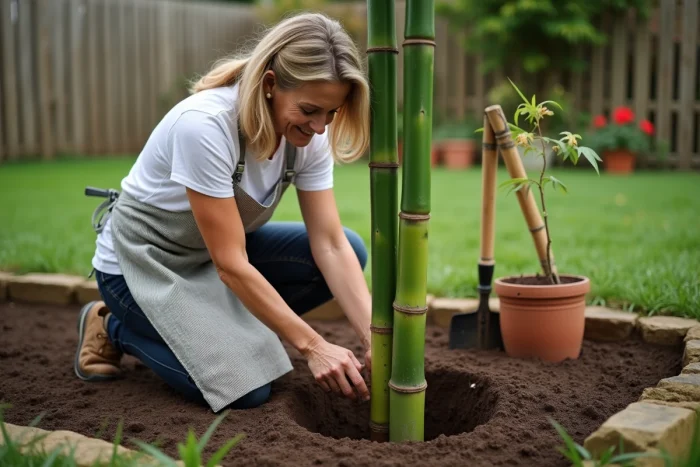
Preparation of the cane before sealing
Before inserting the metal rod, drill the internal nodes of the bamboo using a long drill bit or a pry bar. Without this operation, rainwater accumulates between the partitions and accelerates internal rot.
Then apply a water-repellent treatment to the part that will be buried. Boiled linseed oil, heated and applied with a brush, forms an effective barrier against soil moisture. Two coats are sufficient if the bamboo has been properly dried beforehand (residual moisture below the fungal degradation threshold).
Helical stake and reversible anchoring for garden bamboo
Several French and Swiss municipalities now require reversible anchoring methods in family and shared gardens, particularly to protect buried networks (water, gas, fiber optics). The helical stake, screwed into the ground by hand or with a drill adapter, perfectly meets this requirement.
The principle involves screwing the anchor into the ground, then fitting the base of the bamboo onto the plate or sleeve of the stake. The cane does not directly touch the damp soil, which extends its lifespan.
When to prefer the helical stake over concrete sealing
- For temporary or seasonal structures (tomato stakes, climbing bean teepees, summer decorative arches) that you dismantle each autumn.
- In clayey or waterlogged soil, where concrete sealing creates a retention basin harmful to the bamboo.
- When the shared garden regulations prohibit permanent foundations, as stipulated by certain recent municipal charters.
The helical stake has a limitation: it does not withstand significant lateral loads as well. For a bamboo fence exposed to prevailing winds, hybrid sealing remains more reliable.
Bevel, drainage, and ventilation of the buried base
Trimming a slight bevel at the lower end of the cane facilitates insertion and reduces fiber splitting during installation. The bevel should remain moderate (about a 45-degree angle on one side) to avoid weakening the bamboo wall.
Tests on bamboo used as vine stakes show that a transverse drilling a few centimeters from the base, combined with a layer of draining gravel at the bottom of the hole, significantly increases the lifespan of the cane in contact with the soil. The drilling prevents water stagnation inside, and the gravel stops capillary rise.
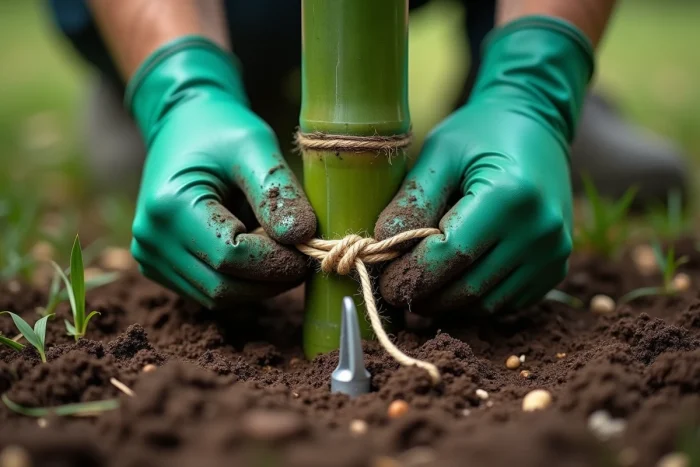
Installation protocol for drained anchoring
- Dig a hole with a diameter double that of the cane, at least 30 centimeters deep for moderately tall bamboo.
- Place a layer of crushed gravel at the bottom to ensure drainage, then position the beveled bamboo.
- Fill with a mixture of gravel and compacted soil in successive layers, ensuring the cane is well supported vertically.
- If you choose to seal with mortar, leave an annular space of a few millimeters between the cane and the concrete, filled later with sand, to allow the bamboo to “breathe” without splitting due to frost.
Common mistakes that condemn the fixation in less than a year
Driving bamboo directly into clayey soil without drainage remains the most common mistake. The cane rots from the base within a few months, loses its rigidity, and eventually breaks off at ground level with the first serious gust of wind.
Using non-galvanized wire to tie the canes to a metal stake causes rapid corrosion. Oxidation stains the bamboo and weakens the connection. We prefer polypropylene rope or stainless steel wire for any external bracing.
Neglecting to dry the bamboo before installation is another source of failure. A still-green cane shrinks as it dries, loosening the fixings and creating play in the sealing. Work exclusively with well-dried bamboo, stored in a sheltered place for at least several weeks.
The choice of anchoring method depends on the function of the bamboo (stake, fence, decorative structure), the type of soil, and exposure to wind. A helical stake is sufficient for a seasonal stake. A hybrid steel-concrete anchoring is necessary for a permanent fence. In all cases, the drainage of the base and protection of the buried cane determine the longevity of the installation much more than the method of fixation itself.