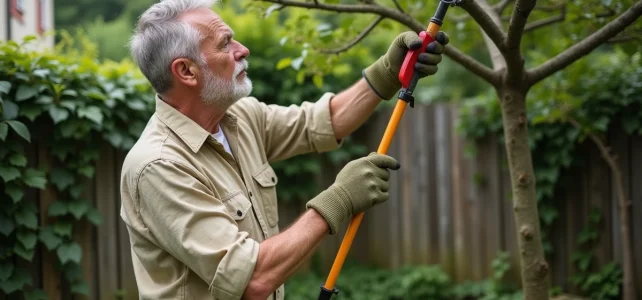
A dead branch rubbing against the gutter, a fruit tree overflowing into the neighbor’s yard, a linden tree with low branches obstructing passage: these are the concrete situations that lead to the search for a pole saw. The choice of the right model depends less on the brand than on your terrain, the height of the cuts, and the time you plan to dedicate to it.
Pole saw in an urban garden: when portability changes everything
Have you ever tried maneuvering a three-meter pole between a shared fence and a garden shed? In urban areas, plots rarely exceed a few hundred square meters. The paths are narrow, the ground is often concreted or paved, and storage is limited to a shed.
In this context, the weight of the tool becomes the primary selection criterion. A powerful but heavy thermal pole saw quickly tires the arms and shoulders when working with the head raised. Battery models, lighter by several hundred grams, allow for short work sessions without pain.
The ergonomic survey by ANSES published in April 2026 confirms this logic: pole saws equipped with a pivoting pole reduce musculoskeletal disorders by about 30% among amateurs. On hard ground where you can’t set up a stable step ladder, this articulation of the cutting head prevents back twisting to reach a lateral branch.
If your garden consists of just two or three trees and storage is limited, opt for a compact battery model with a retractable telescopic pole. This type of pole saw can be stored in a closet and taken out in five minutes. To explore the available ranges, you will find a detailed comparison on elagueuse-warrior.com, with sheets focused on domestic uses.
Battery, electric corded, or thermal: which motor for which use
The type of motorization determines autonomy, noise, and maintenance. Here are the three categories and their concrete use cases.
Battery pole saw
This is the natural choice for an individual who prunes their trees two to three times a year. No cord to pull in the garden, no oil-gas mixture to prepare. Autonomy varies according to battery capacity, generally between 18 V and 36 V for consumer models.
The limitation appears with thick branches or prolonged sessions. If you need to prune more than ten large branches, plan for a spare battery.
Corded electric pole saw
Plugged into an outlet, it offers constant power without the need for recharging. Common models range around 750 W to 800 W, which is sufficient for medium-diameter branches. The cord remains its main drawback: it limits the working radius and creates a risk of snagging in the branches.
Thermal pole saw
Reserved for large properties or frequent cuts on hard wood. A thermal engine delivers more power and operates without time limits, but it is heavier, vibrates more, and requires regular maintenance (spark plug, filter, fuel). For an urban garden, it is often oversized, not to mention the noise nuisance for the neighbors.
Guide length and chain: adapting the cut to the diameter of the branches
The guide bar is the visible blade at the end of the pole saw. Its length determines the maximum diameter of branch you can cut in a single pass.
- A 20 cm guide is suitable for fine twigs and branches, typical of regularly pruned fruit trees or ornamental shrubs.
- A 25 cm guide covers the majority of domestic pruning tasks: dead branches, new growth from the year, small oak or birch twigs.
- A 30 cm guide or longer is aimed at thick branches and hard wood. It requires a sufficiently powerful motor to drive the chain without straining.
Choosing a guide that is too long for a small motor slows down the cut and prematurely wears out the chain. The consistency between the length of the guide and the power of the motor matters more than the size of the guide alone.
Also consider the chain pitch. Low-profile chains (3/8 inch pitch) vibrate less and are suitable for amateurs. Standard pitch chains cut faster but require more skill.

Telescopic pole saw: reaching height without a ladder
The telescopic pole transforms a compact pole saw into a tool capable of reaching branches several meters off the ground. You stay on the ground, which reduces the risk of falling, the leading cause of accidents during amateur pruning.
There are two configurations. The fixed pole offers more rigidity and is suitable when the working height is known in advance. The telescopic pole, adjustable in length, adapts to trees of varying sizes but may have slight play at the joints.
Before buying, check the maximum length of the deployed pole and compare it to the height of your trees. Add about 1.80 m (your own height with arms raised) to estimate the actual reach. If your trees do not exceed four or five meters, a two-meter pole is more than sufficient.
Weight and balance in the high position
The longer the pole, the more the leverage effect tires the arms. A three-meter model weighing over five kilograms becomes difficult to handle beyond ten minutes of continuous use. Test the balance of the tool with arms extended before purchase, or consult user feedback on comfort in the high position.
A shoulder harness, sometimes sold separately, distributes the weight across the torso and significantly extends working time without pain.
The right choice of pole saw relies on three concrete elements: the size of your terrain, the diameter of the branches to be cut, and the maximum height of your trees. A battery model with a telescopic pole and a 25 cm guide covers most domestic needs. Keep in mind that a tool suited to your physique and space will serve you for years, whereas a model that is too powerful or cumbersome will end up gathering dust in the back of the garage.