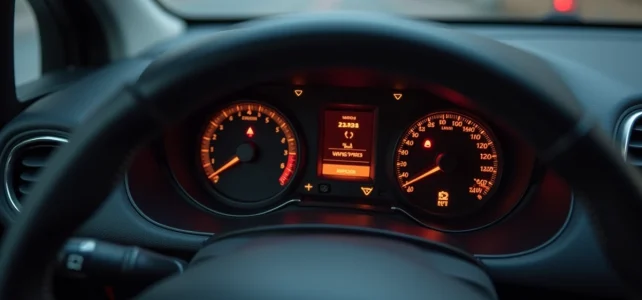
Driving on a departmental road, an orange icon lights up on the Peugeot 208’s dashboard, and the first instinct is to look for the user manual in the glove compartment. The problem is that most drivers never open it before that moment. Understanding the dashboard indicators of the Peugeot 208, however, helps avoid two pitfalls: panicking over an informational warning or ignoring an alert that requires immediate action.
Orange Engine Light on Peugeot 208 PureTech: What the Euro 6d Standard Changed
On second-generation 208s equipped with the 1.2 PureTech engine, the orange engine light comes on more often than one might think without any noticeable mechanical symptoms. Since the implementation of the Euro 6d standard, this indicator frequently reacts to a temporary exceedance of NOx or particulate emission thresholds, particularly after a series of short urban trips.
Specifically, you start in the morning for a five-minute drive, the catalyst doesn’t reach its operating temperature, and the computer records a discrepancy. After a few cycles, the engine light comes on without any actual mechanical failure. Several Peugeot dealerships are now applying a software update that modifies the ignition strategy of this light, with a quicker transition to limp mode to protect lubrication, especially in case of detected degradation of the wet belt.
When consulting the list of dashboard indicators for the Peugeot 208, it is noted that the orange engine light covers a wide spectrum, from simple emission faults to injection problems. The best approach: connect an OBD-II reader to read the fault code before making an appointment at the workshop.
Specific e-208 Indicators: High Voltage and Charging
Most guides treat the indicators of the 208 as if all versions share the same alerts. However, the electric e-208 includes high voltage indicators that are absent from the thermal version, and confusing them can pose a real safety issue.

Three icons deserve special attention on the e-208:
- The orange triangle “electrical fault” indicates an anomaly in the high voltage circuit. It requires not to intervene under the hood and to contact assistance.
- The battery icon with an exclamation mark indicates a malfunction of the traction battery, not the standard 12V battery. A quick and safe stop is recommended.
- The charging cable symbol alerts to a connection or communication problem with the charging station. Unplug, wait a few seconds, then reconnect before suspecting a hardware fault.
After a collision, even minor, the manufacturer’s instruction for the e-208 is clear: do not touch the vehicle until the high voltage system has been secured by a qualified technician. Towing with the wheels on the ground is prohibited in certain cases, which is completely different from the thermal protocol.
Red, Orange, Green Indicators: Prioritizing the Response on the Ground
The color code of the Peugeot 208 dashboard works like a traffic light, but the associated ground response for each color is rarely well understood.
Red: Stop the Engine
A red light (oil pressure, engine temperature, STOP alert, braking) means to stop as soon as traffic allows. Continuing to drive with a red light on risks causing irreversible damage to the engine. First, check the oil level and coolant. If the light persists after restarting, it’s time for a tow.
Orange: Diagnose Within a Few Days
Orange covers the engine light, pollution alert, tire pressure monitoring system (TPMS), or ESP. The vehicle remains drivable in most cases, but delaying diagnosis beyond a week increases the risk of secondary failure. Feedback varies on this point: some drivers drive for weeks without issues, while others see the problem worsen in a few days.
Green and Blue: Confirmation of Operation
Low beams, turn signals, active cruise control: these green or blue indicators require no action. The blue high beam light simply reminds you to switch back to low beams when facing another vehicle.

Peugeot 208 Indicator Diagnosis: OBD-II Reader or Dealership Visit
When an orange light persists, two options are available. The first is to use an OBD-II device plugged into the diagnostic port, located under the steering wheel on the left side of the 208. The device reads fault codes (format P0xxx, C0xxx, etc.) and helps determine if the issue relates to injection, the pollution control system, a sensor, or the braking circuit.
A fault code alone does not always indicate which component to replace. It indicates a circuit or measurement out of tolerance. On the 1.2 PureTech, a P0420 code (catalytic converter efficiency insufficient) could come from the converter itself, a worn lambda sensor, or simply from repeated too-short trips.
The second option, visiting a dealership or a garage equipped with Peugeot Planet software, provides access to more detailed data: real-time sensor values, fault history, and the possibility to reprogram the computer if an update is available.
- Before the appointment, noting when the light came on (cold start, while driving, after refueling) helps the technician focus the diagnosis.
- Clearing a fault code without fixing the cause only temporarily turns off the light, which will return in the next cycle.
- On the e-208, high voltage codes should never be cleared by an individual: this manipulation requires electrical authorization.
The dashboard of the Peugeot 208 continuously communicates the vehicle’s status. The color indicates the level of urgency, the icon identifies the concerned system, and the OBD-II reader translates the message into an actionable code. Keeping a device in the glove compartment remains the most cost-effective gesture to avoid an unnecessary trip to the workshop.