
In France, the nursing profession constitutes the largest health workforce in terms of practitioners. These professionals perform technical procedures, clinical monitoring, therapeutic education, and provide human support at every stage of the care pathway. Their scope of intervention extends from the hospital to the patient’s home, including medical-social structures and private practices.
Discrepancy between recognized skills and actual practice on the ground
The law of June 27, 2025, the first framework law dedicated to the nursing profession, has included in the Public Health Code acts that are already performed daily: nursing consultation, nursing diagnosis, prescription under certain conditions. The decree of December 24, 2025, clarified the application modalities.
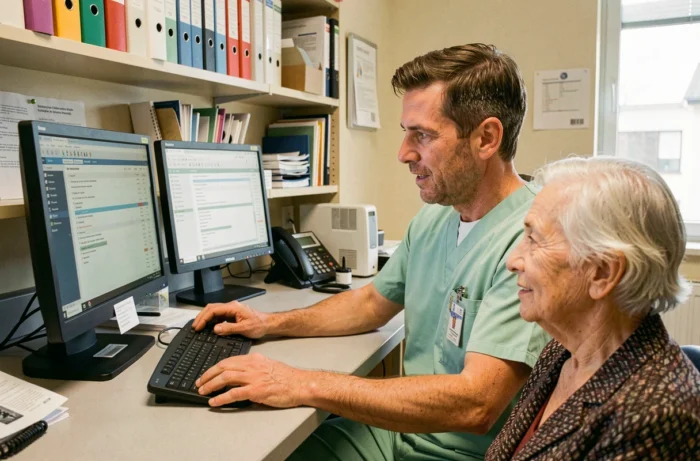
On paper, this legal framework clarifies the distinct role of the nurse and paves the way for a more autonomous practice. In practice, implementation remains uneven. Parliamentary questions submitted to the Senate indicate that the software used in establishments is not all adapted to nursing prescriptions. Some tools simply do not allow for tracking a nursing consultation in the patient record.
This gap between the law text and operational reality hinders the concrete application of new skills. A union like convergenceinfirmiere.fr regularly raises awareness about these technical barriers that slow down the scaling up of the system.
Access to nursing care: territorial disparities persist
The nursing profession is often presented as a network of proximity covering the entire territory. Data from Insee nuance this image. In 2024, potential accessibility to nurses varied significantly between municipalities and even slightly deteriorated compared to 2023.
In other words, the national presence of a profession does not guarantee real access to care in every living area. Two phenomena are cumulative:
- The concentration of private practices in urban or coastal areas, to the detriment of under-resourced rural or suburban territories
- The aging population, which increases the demand for home nursing care in areas where supply is stagnant or declining
- The absence of binding regulation on establishment, unlike what exists for pharmacies, for example
The expansion of skills voted in 2025 does not automatically translate into better access to care. Without action on the geographical distribution of staff, reforms mainly benefit already well-endowed territories.
Advanced practice nurse: a status that redefines boundaries
The status of advanced practice nurse (IPA) represents a structural change in the organization of care. An IPA can monitor patients with stabilized chronic conditions, renew medical prescriptions, or perform technical procedures previously reserved for doctors.
This positioning creates an intermediate level between the state-certified nurse and the doctor.
What advanced practice changes in the patient pathway
For a patient being monitored for a chronic illness (diabetes, heart failure, respiratory disease), the IPA becomes a regular contact capable of adjusting treatment without waiting for a medical appointment. The time between the onset of a symptom and therapeutic adjustment is reduced, which limits avoidable complications and emergency visits.
The issue of direct access remains a challenge for advanced practice. Allowing patients to consult directly with an IPA, without first going through a doctor, would improve the fluidity of the pathway in areas where medical consultation wait times exceed several weeks.
Projection of nursing staff in the face of demographic aging
Projections published by Insee indicate that the demand for nursing care would grow faster than the number of employed staff by 2050. The aging of the French population leads to a mechanical increase in the demand for long-term care, home support, and end-of-life assistance.
This foreseeable imbalance raises a question of the overall capacity of the system, distinct from the mere distribution of skills. Training more nurses is not enough if working conditions (remuneration, workload, statutory recognition) do not allow them to remain in their positions.
Training and attractiveness of the nursing profession
The initial training pathway in nursing lasts three years and alternates between theoretical teachings and clinical internships. The university integration of the curriculum, initiated several years ago, aims to bring nursing education closer to European standards and facilitate pathways to advanced practice or research.
However, the attractiveness of the profession remains a point of tension. The physical and psychological strain affects the retention of professionals, particularly in high-demand hospital services (emergency, geriatrics, intensive care). The rate of career change to other sectors, although not precisely quantified in recent public data, is a monitored indicator by the authorities.
The 2025 law provides a long-awaited legal foundation for the profession. Its concrete effect will depend on the ability of institutions to adapt their tools, the political will to act on territorial distribution, and the maintenance of a sufficient training flow to absorb the growing demand for care in the coming decades.