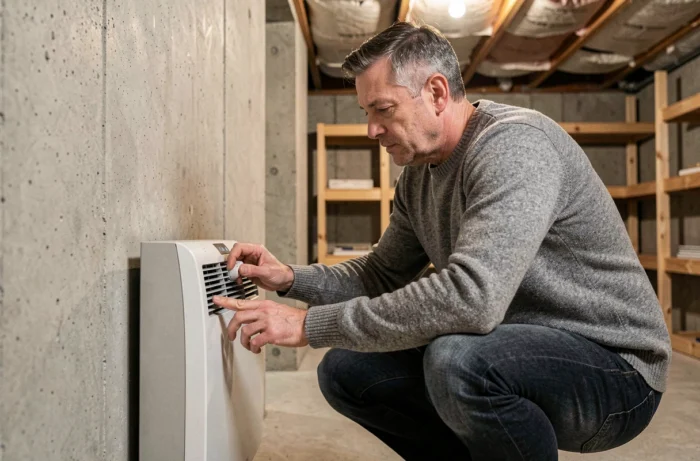
A basement naturally maintains a temperature of around 10°C to 12°C, depending on how deep it is, the type of construction, and the quality of the insulation.
This relative thermal stability does not mean the room is ready to be heated: ambient humidity, air leaks, or a lack of ventilation can make any heating system ineffective or even counterproductive. Before investing in equipment, assess the room to determine the right system and energy costs.
Cold or damp: assess the problem before buying a heating system
The usual response is to install a radiator as soon as a basement feels uncomfortable. This overlooks a key factor: the room’s relative humidity can exceed the critical threshold even as the temperature rises. Heating a damp room without addressing the cause increases your energy bill without improving comfort.
To determine whether the problem is cold or damp, place a hygrometer in the basement for a few days to get a reliable initial reading. If the relative humidity regularly exceeds 65% to 70%, the basement needs ventilation or waterproofing work before any heating system is installed.
Partially below-ground basements with windows are more exposed to cold air infiltration, but are also easier to ventilate. Fully underground cellars have more stable temperatures, but are at greater risk of condensation on cold walls. To choose an efficient heating system for your basement, address these two issues first: insulate walls in contact with the ground and ensure a minimum level of air exchange.
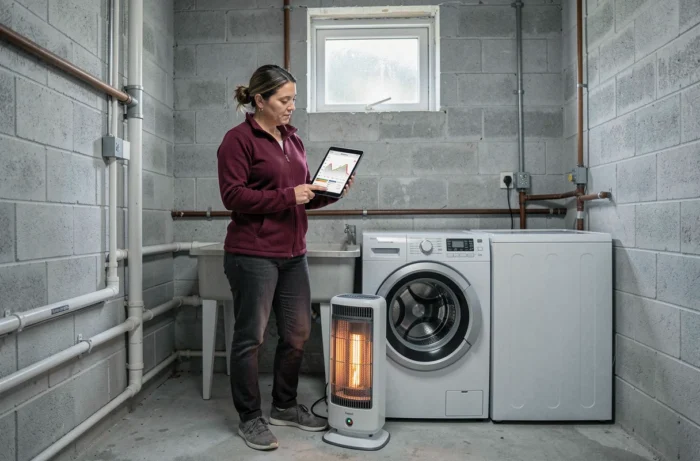
Basement insulation and ventilation: improvements that cut costs before you heat
A poorly insulated basement loses heat through its underground walls and floor slab. Insulating these surfaces before heating significantly reduces energy needs. Older buildings often have bare concrete-block walls in direct contact with the ground, with no vapor barrier or insulation.
Interior insulation (rigid or spray-applied panels) is the most accessible option for renovations. It reduces the usable floor area by a few centimeters, but creates a thermal barrier that limits heat loss and condensation on cold walls.
Mechanical or natural ventilation
Without air exchange, a heated basement accumulates moisture generated by everyday use (breathing, laundry, appliances). In most layouts, a single-flow mechanical ventilation system with an exhaust vent in the basement is sufficient. For fully underground basements with no openings, a local mechanical ventilation unit (VMP) is a less invasive alternative to install.
An efficient heating system in an unventilated basement makes damp problems worse rather than solving them. Warm air absorbs more moisture, which then settles on the remaining cold surfaces (corners, ceiling, pipes).
Electric radiator, heat pump, or connection to the central heating system: which option suits your needs?
The right system depends on two factors: how often the basement is used and whether the house has a central heating system.
Extend the existing hydronic circuit
If the house has a boiler or heat pump with a hydronic circuit, connecting one or two radiators in the basement is often the most economical option to run. However, the boiler must be sized to handle the additional area. A professional can check that its available output meets the extra demand without overloading the unit.
- A low-temperature hydronic radiator works well with air-to-water heat pumps and helps limit overall electricity consumption.
- Hydronic underfloor heating, an option in new builds, distributes heat evenly but requires a screed layer that reduces ceiling height.
- Connecting to the existing system avoids the need for an additional utility contract or separate meter, making bills easier to manage.
Electric radiator: flexibility at the cost of higher electricity bills
For a basement used occasionally (as a workshop, gym, or laundry room), an electric thermal-inertia radiator is a reasonable compromise. The upfront cost is low, but running costs are the highest among fixed options.
Fan heaters and basic convectors are best avoided: they dry the air near the surface without warming the walls, increasing discomfort and encouraging you to raise the thermostat setting. A radiant panel or ceramic thermal-inertia radiator distributes heat more evenly.
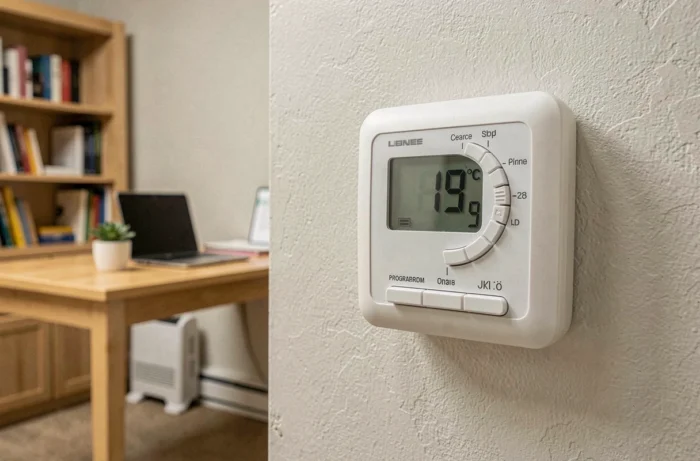
Space heaters: a temporary fix, not a long-term solution
Paraffin heaters, oil-filled radiators, and portable convectors have high running costs and raise safety concerns in poorly ventilated spaces. A basement space heater should only be used for occasional needs, for no more than a few hours a week.
In an enclosed basement, a combustion heater (wood or paraffin) requires a compliant flue to vent exhaust gases. Without one, there is a real risk of carbon monoxide poisoning. Open-flame appliances are also not recommended in rooms without direct access to the outdoors.
Thermostats and scheduling: the most overlooked way to lower your bill
Choosing a heating system gets all the attention, but controls often make the biggest difference to your bill. A basement used as an office during the day and left empty in the evening does not need to stay at a constant temperature.
- A programmable thermostat lets you lower the setting to 14°C–15°C when the room is unoccupied and raise it to 19°C–20°C an hour before use.
- Electric thermal-inertia radiators with built-in controls (pilot wire or smart controls) offer this feature without requiring additional installation.
- On a hydronic circuit, a thermostatic valve on each basement radiator allows it to be controlled independently of the rest of the house.
Lowering the thermostat by a few degrees when the room is unoccupied reduces energy consumption without letting it get so cold that condensation starts again. The aim is to keep the walls warm enough to prevent thermal bridging while limiting the time spent heating at full power.
A basement is a room with its own thermal management needs. Its relatively stable natural temperature is an advantage when insulation and ventilation are adequate. A properly sized heating system, combined with a schedule tailored to how the room is actually used, can improve comfort without letting energy bills spiral.