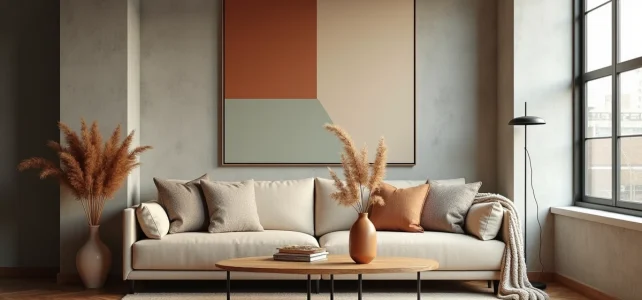
What criteria distinguish a sustainable decor trend from a passing fad that complicates the resale of a property? Feedback from home staging professionals in France since 2023 highlights a clear gap between interiors strongly marked by a bold style and those whose personalization relies on movable elements. This opposition currently structures choices in interior decoration, well beyond seasonal color palettes.
Visual and acoustic comfort: the forgotten criteria of interior decor
Most decor trend guides detail palettes, textures, and furniture shapes. However, interior design has documented effects on concentration and mental health, especially with the rise of remote work.
Two parameters remain underrepresented in trend articles: lighting management and sound reverberation reduction. Textiles (thick curtains, rugs, cushions) play a direct role in a room’s acoustics. The arrangement of furniture alters the diffusion of natural light in a living room or workspace.
Before choosing a decor style, it is more useful to map out the sources of light and noise zones in each room. An interior where one can discover decor on Maisonisor by combining aesthetics and functional comfort produces a result that lasts over time.
| Criterion | Purely aesthetic approach | Approach integrating comfort |
|---|---|---|
| Lighting | Fixtures chosen for their design | Fixtures positioned according to activity zones |
| Acoustics | Decorative textiles (visual aspect) | Absorbing textiles (heavy curtains, dense rugs) |
| Furniture | Symmetrical or trendy arrangement | Arrangement adapted to circulation and light |
| Resale | Strong style, difficult to neutralize | Personalization through movable elements, neutral walls |
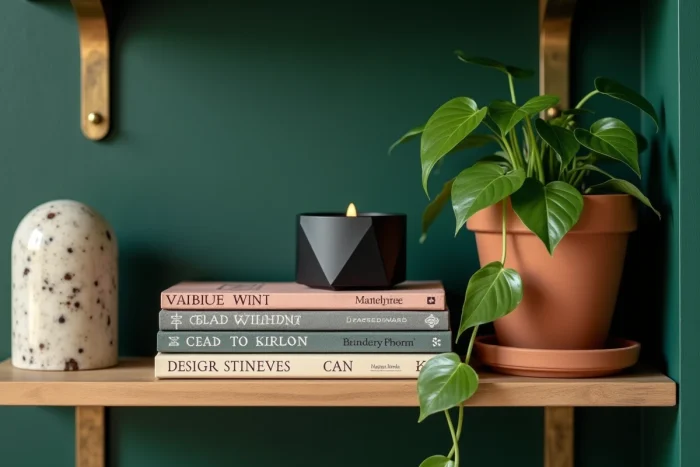
Strong trend or movable personalization: impact on property resale
Real estate and home staging professionals in France have observed since the rise in rates in 2023 that interiors strongly marked by a trend sell less quickly. A living room entirely painted in a saturated color or maximalist wallpaper on four walls creates a barrier for potential buyers.
In contrast, interiors whose personality relies on easily replaceable elements (textiles, fixtures, art objects, plants) can be neutralized in just a few hours before a visit. This observation guides a precise decor choice: neutral walls and character brought by furniture and accessories.
Which movable elements to prioritize for reversible decor
- Cushions and throws allow for a color palette change in a living room in an afternoon, without touching the walls or floor
- Floor lamps or repositionable cable suspensions modify the lighting ambiance and perceived style of a room
- Frames, posters, and art objects placed on shelves (rather than fixed) adapt to desires without leaving marks
This logic does not mean giving up a strong style. It focuses on concentrating the decor identity on pieces that can be taken along in case of a move.
Creative micro-spaces: decor trends driven by passions
Studies by ADEME and the Habitat Observatory have reported since 2023-2024 a notable increase in creative micro-spaces in urban housing. Workshop corners, music zones, DIY or digital creation spaces: those aged 25-40 are reconfiguring their interiors around a personal activity rather than an abstract style.
This phenomenon reverses the usual logic of decor trends. Instead of starting from a visual inspiration (Scandinavian, Japandi, maximalist) to dress a space, the starting point becomes usage. The decor is organized around what one does in the room.
Designing a creative corner without sacrificing living space
In an urban apartment, the available surface imposes trade-offs. A creative desk integrated into a closing piece of furniture, a magnetic tool wall in the entryway, or a folding table dedicated to drawing in the living room: each solution relies on modular and retractable furniture.
The design of these micro-spaces follows a technical constraint more than an aesthetic one. The lighting must correspond to the activity (directional light for drawing, diffuse light for music). Storage must make materials accessible without cluttering the passage.
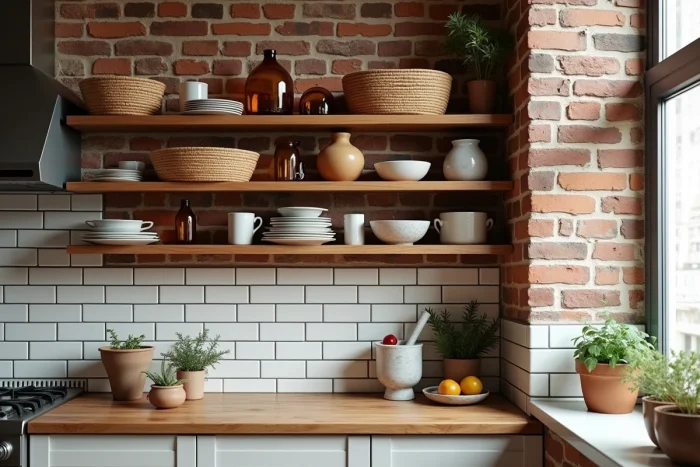
Colors and materials in 2026: what field data indicates
Earthy tones and raw materials (untreated wood, linen, stone) dominate recent collections. This orientation is part of a continuity with ecological concerns that have influenced interior decoration for several years.
Natural fibers present a measurable double advantage: they contribute to the acoustic absorption of a room and can be replaced at a lower cost compared to wall coverings or flooring. A jute or thick wool rug alters the sound perception of a living room as much as its appearance.
Saturated colors do not disappear, but their usage shifts. They appear on targeted elements (a touch of color on an armchair, a vase, a frame) rather than on permanent surfaces. This approach by touches allows for following trends without irreversible commitment.
The choice between natural materials and industrial finishes depends less on personal taste than on the actual use of the room. A family living room struggles with a light linen sofa without stain treatment. A workspace benefits from neutral tones rather than a bright accent wall. A decor that starts from daily use ages better than a decor based on a fleeting visual inspiration.